 What If UniverseOpen the simulator
Tsunami simulator
Set off an undersea earthquake or drop an asteroid in the sea and follow the waves across the ocean, hour by hour, until they reach the far shores.
 Try it now: free, in your browser
How the waves travel
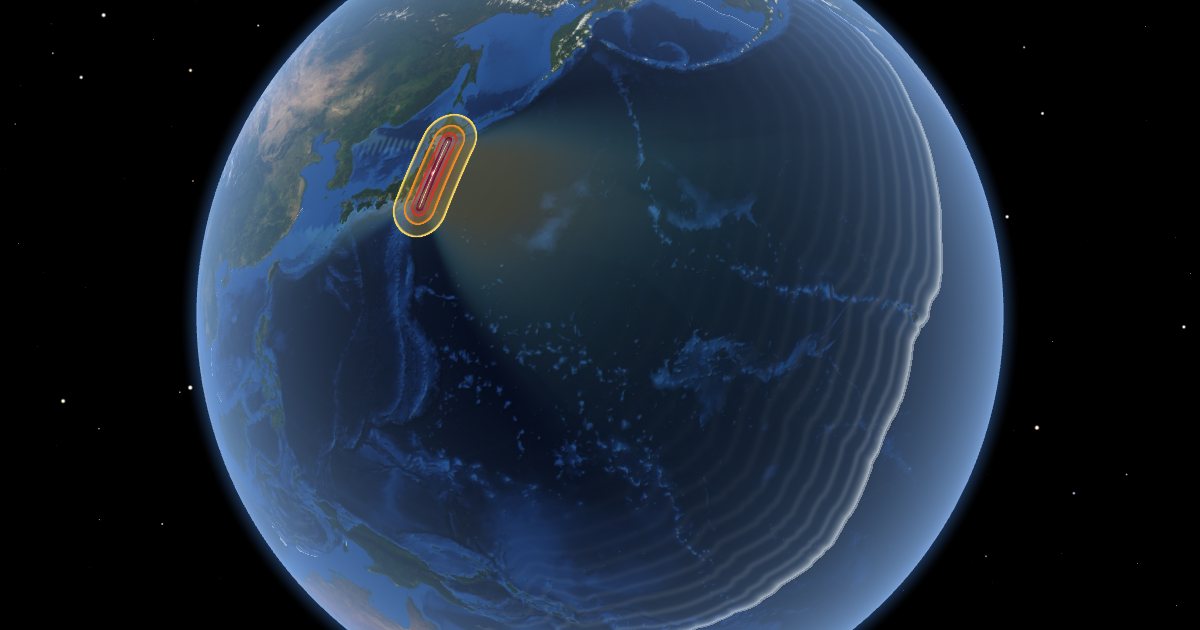
A tsunami moves at a speed set by the depth of the water: about 700 km/h over the deep ocean, slowing as it reaches the coast and rising as it slows. The simulator sends the wave across a map of the real sea floor, so it bends around islands, is shielded by land and squeezes through straits the way real waves do.
The map shows the wave front and, behind it, the highest wave each part of the sea has seen. Long faults lift the sea floor most in the middle and send the biggest waves out sideways.
Who is affected
For every stretch of coast the simulator counts the people living low enough to be reached, how much warning they had and how well prepared the country is. Places hit within minutes suffer most; coasts reached hours later have time to flee. That is why the 2004 Indian Ocean tsunami killed so many in Aceh and fewer people further away.
Questions
How fast does a tsunami travel?
In the deep ocean about 700 to 800 km/h, as fast as a jet plane. It crosses the Pacific in less than a day.
What causes the biggest tsunamis?
Great undersea earthquakes on subduction faults, like Sumatra 2004 and Tōhoku 2011, and large asteroid impacts in the ocean.
Why did the 2011 tsunami kill fewer people than the 2004 one?
Japan had warnings, sea walls and evacuation drills, and much of its coast had a few minutes to react. In 2004 there was no warning system in the Indian Ocean.
All numbers in the simulator are rough estimates meant to show what could happen, not predictions.